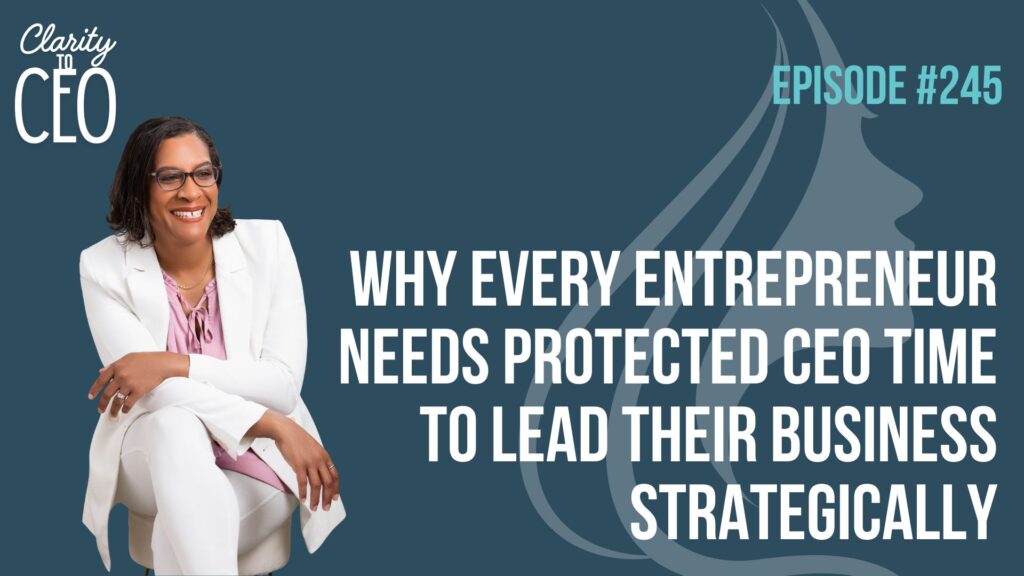
If someone looked at my calendar several years ago, they probably would have assumed my business was thriving and that I had protected CEO time.
My days were packed with client meetings, networking events, emails, content creation, and delivering work. I was productive by almost every traditional measure. Every hour had a purpose, and every task felt important.
What my calendar didn’t reveal was that I had very little space to think.
I was spending all of my time working in my business and almost no time leading it.
That realization changed everything.
In this episode of Clarity to CEO, I share one of the most valuable leadership habits I’ve developed over the years: protecting dedicated CEO time. This isn’t about finding another productivity hack or squeezing more work into your week. It’s about intentionally creating space to think strategically so your business grows with purpose instead of simply growing busier.
Busy Does Not Always Mean You Are Leading [00:01:00]
One of the biggest misconceptions entrepreneurs carry is believing that a full calendar automatically means meaningful progress.
The reality is that many business owners spend their days responding, delivering, solving problems, and checking items off their to-do lists. While those activities are necessary, they often leave very little room for strategic thinking.
That was exactly where I found myself.
My calendar was full, but my thinking space was empty. I was operating like an employee inside my own business rather than the CEO responsible for leading it.
Leadership requires something different.
It requires intentional pauses to evaluate where the business is headed, whether current decisions still align with long-term goals, and what adjustments need to be made before small issues become larger problems.
Protected CEO Time creates that space.
Protected CEO Time Is Scheduled, Not Found [00:02:00]
One of the most important lessons I learned is that no one will ever hand you time to think.
If your calendar has open space, something will inevitably fill it.
A client schedules a meeting. Emails continue arriving. New opportunities appear. Administrative work expands to consume whatever time is available.
That is why Protected CEO Time must be scheduled with the same level of commitment as any client appointment.
For me, this means intentionally blocking time on my calendar where I am unavailable for meetings, emails, and daily execution. During those hours, my responsibility shifts from doing the work to leading the business behind the work.
At first, protecting this time felt uncomfortable.
Like many entrepreneurs, I equated visible activity with productivity. Sitting quietly to think almost felt unproductive.
What I eventually realized was that some of the most valuable business decisions I have ever made happened during those protected blocks of reflection.
What I Actually Do During Protected CEO Time [00:03:00]
One question I receive often is whether CEO Time simply means sitting quietly and thinking.
The answer is no.
My Protected CEO Time follows a consistent framework that keeps me focused on the areas that have the greatest impact on my business.
Strategy
The first question I ask is whether my current priorities still align with my long-term vision.
Am I focused on the initiatives that will move the business forward, or have I become distracted by urgent tasks that simply keep me busy?
Strategy requires continual refinement because businesses evolve, markets shift, and opportunities change.
Messaging
Next, I review my messaging.
Is what I am communicating still attracting the clients I most want to serve?
As our businesses grow, our messaging should evolve alongside them. Regular CEO reflection helps ensure our communication continues to reflect the business we are building rather than the business we operated last year.
Offers
I also evaluate my current offers.
Do they still align with my capacity?
Are they solving the right problems?
Have I outgrown something that no longer fits the direction of my business?
Sometimes the greatest opportunity for growth is not creating something new. It is refining what already exists.
Systems
Finally, I review the systems supporting my business.
Where is friction appearing?
Which processes consume more time than they should?
What adjustments would improve efficiency for both my clients and my team?
Systems are never truly finished.
They should continue evolving as the business grows.
Reflection Helps You Catch Misalignment Early [00:05:00]
One of the greatest benefits of Protected CEO Time is that it allows you to notice problems before they become crises.
Misalignment rarely happens overnight.
Instead, it develops quietly.
Your messaging slowly becomes less effective.
Your content no longer feels aligned with your audience.
Your offers become heavier to deliver than they once were.
Your systems begin creating more friction than support.
Without intentional reflection, those small shifts continue unnoticed until they eventually affect both your confidence and your results.
Protected CEO Time allows you to pause, observe what has changed, and make thoughtful adjustments before your business drifts too far away from your vision.
That is proactive leadership.
Clarity Is Not a Destination. It Is a Practice. [00:06:00]
One of the themes woven throughout my upcoming book, When Clarity Leads, is that clarity is not something we discover once and hold onto forever.
Clarity requires ongoing attention.
As your business grows, your leadership must grow alongside it.
New opportunities require new decisions.
Changing markets require updated strategies.
Personal priorities evolve, and your business should evolve with them.
Protected CEO Time creates the environment where those adjustments can happen intentionally rather than reactively.
Leadership is not built through constant motion.
It is built through thoughtful reflection followed by intentional action.
Protected CEO Time Is an Investment, Not an Interruption [00:07:00]
Many entrepreneurs hesitate to block time for strategic thinking because they believe they cannot afford to step away from execution.
I would argue the opposite.
You cannot afford not to.
Even one hour each week dedicated to Protected CEO Time can completely change how you make decisions, evaluate opportunities, and lead your business.
That hour may help you:
- Identify unnecessary work
- Clarify your messaging
- Improve an offer
- Strengthen your systems
- Realign your priorities
- Prevent future overwhelm
The return on that investment extends far beyond the sixty minutes you set aside.
It influences every decision that follows.
Frequently Asked Questions
What is Protected CEO Time?
Protected CEO Time is dedicated, uninterrupted time reserved for strategic thinking, planning, evaluating, and making leadership decisions rather than completing day-to-day operational tasks.
Why is CEO Time important?
CEO Time creates space to evaluate strategy, refine messaging, improve systems, and make proactive decisions before problems become larger challenges.
How much Protected CEO Time should entrepreneurs schedule?
Even one hour each week can significantly improve clarity, decision-making, and business alignment.
What should I review during CEO Time?
Review your strategy, messaging, offers, systems, and any areas where your business may be drifting away from your long-term goals.
How does Protected CEO Time improve leadership?
It allows entrepreneurs to shift from reactive decision-making to intentional leadership by creating space for reflection, evaluation, and strategic planning.
The Next Step
If you’re ready to move beyond constant execution and begin leading your business with greater intention, I invite you to join the Strategic Clarity Workshop (Free Event).
Together, we’ll build a strategic roadmap that helps you create stronger systems, clearer messaging, and more confident leadership decisions.
And if today’s conversation resonated with you, be sure to sign up to be notified when my upcoming book, When Clarity Leads, is released. When the book launches, you’ll also receive access to The CEO Shift, my companion course designed to help you apply these principles and step fully into your role as a strategic leader.